Category Archives: Objects

Diploma

diploma_sm.jpg

My diploma finally showed up in the mail about a week ago, and I feel compelled to put a picture of it online to brag, especially for the contingency that I need to link it to prove my credentials in matters electronic (yes, even college degrees can be reduced to “I’m going to use it to be a jerk on the Internet”). I was curious how they were going to fit 3 degrees; apparently UK isn’t especially well prepared to handle people earning more than two simultaneous degrees, and there is even some sort of opposition to people trying the EE/CompE/CS trifecta, but the engineering staff are seeing to it that we get our diplomas. I’m pleased that the major with which I most associate is the big one, but I’m a little disappointed they didn’t fit the math minor on, my transcript says I did get it.

Posted in General, Objects, OldBlog, School | Tagged | Leave a comment

CNC Beginnings

The beginnings of my CNC project, in the form of parts for the XY table, and associated tool pile:
XYParts_sm.jpg
The motion capability will be 9” in the X dimension and 6” in the Y direction, the Z axis is on hold until after the semester is over, there just isn’t time to design it in now.
Drives:
Each axis will be driven by a 130 oz-in NEMA23 Stepper (Lin Engineering 5618S-58-01)
The lead screw to run the axis is a 3/8” coarse threaded rod, cut to length
The travel nuts are 1.125” coupling nuts (long, to help with backlash without spending money)
One remaining problem is couplers for attaching the lead screw to the drive shaft, there are lots of options, but they all seem to cost at least $10/axis. I suspect unless something better appears I’ll end up with lovejoy couplings.

From aluminum square tubing (1” OD, .062” walls):
8”x8” (outside) square frame for Y axis
6”x12” (outside) rectangle for X axis
The framing will be assembled with bolts, tabs cut from 90deg angle stock, and a bit of epoxy to make it easier.

The next big fuss is figuring out the driver circuits. The motors are rated for 2A at any practical voltage, and only show about 2.6Ohms/coil of resistance, so its going to require proper current-controlled drivers, which may be expensive.

The thing I’m liking most about this project is that I’m learning a huge amount of practical, hands-on knowledge about metalworking and mechanical devices in a hurry, in a low-investment environment so I can experiment and really get a feel for things. I’m not sure if I’ll ever do much more metalwork, but its a good skill to have.

Posted in Announcements, DIY, Electronics, General, Objects, OldBlog | Tagged | 1 Comment

Screen Printing With Bleach

While further procrastinating, I found the ellembee shop at etsy, who sells gorgeous shirts (partly) subtractively printed by screen printing with bleach, which is a damn nifty idea. For those not attuned to that particular bit of interweb, etsy is a website for buying and selling handmade things, mostly crafty in nature, and is a wonderful place to browse for novel objects… like subtractively screen printed shirts.
Ellembee only makes womens shirts or I would already have one of the bleach + chocolate ink “floral” pattern shirts on the way. I’d consider contacting them about making a mens/unisex tee, maybe on one of those amazing universally fitted American Apparel shirts like shirt.woot uses, but I’m a little afraid of how much it would cost… it seems like something perfectly acceptable for a male to wear, but it has long been established that I have slightly effeminate tastes.

Posted in DIY, General, Objects, OldBlog | Leave a comment

Retro Computing

I saw retr0bright, a hobbyist produced restorer for antique plastics go by on the geek newses(first via /.) today. It probably does do a little bit of damage to the plastics when used, but I doubt it’s much worse than another year of aging. I love antique computing tech, and this provides a flimsy excuse to ramble about it a bit instead of working on all the things I should be.

I’m specifically interested in retr0bright for restoring the plastics on the Mac SE I yardsaled some years ago. I picked it up partly out of waning to poke around in a one-piece Mac, and partly because the case information indicates it is +/- a few months of my age, which makes it a nifty conversation piece. The machine is a fun project box as well; Mac SEs have bays for two drives, either two floppy drives or a floppy and a hard drive, I mounted a small spare SCSI hard drive into the internal frame with a little bit of EM shielding, and kept both floppies. Having grown up on Macs (the formative computer for me was a Macintosh Centris 660AV running OS 7.1. The machine is still in my parent’s attic, but I’m fairly certain its video board has died. The SE is sitting on a shelf in my old room in my parent’s house, and when last I tried it was still fully functioning. People who knew me in middle and high school will remember that one side of my room was covered in a selection of aging Apple hardware, it was a big part in making me the hacker I am today.

I am mostly unimpressed by modern Macs (although I wouldn’t mind a Mac or a hackintosh to play with), but still sometimes pine for awesome old mac software; this is what Basilisk][ is for. Coupled with an appropriate ROM image and disc or disc image (both of which I keep around), Basilisk][ can emulate a 68k mac on a Windows, Linux, OS X (and possibly others) host. This lets me reminisce, and play with old software from my childhood without having to bust out any finicky old hardware. A lot of the things I keep on the drive image are games I remember from childhood, especially a couple of old Ambrosia software titles like Barrack (a particularly awesome jezzball-like game) and the first two titles in the Escape Velocity series (which are perfect non-classical RPGs). I also keep a copy of Word 5.1, which is in some ways still the best thing Microsoft ever made, and some other productivity titles from the time. It’s always neat to see what changes and what stays the same.

In the same vein as Basilisk ][, one of my other formative experiences in geekry was learning about emulation, staring with the Super Nintendo and snes9x. The joy of “You can play all those awesome old games on your computer” has always been an almost irresistible motivator, both for myself and for passing on to others. Emulation also provides a great outlet for compulsive behavior for lots of people, especially when you start to look into the world of ROM collectors (ROM in this case refers to software copies of games, which were traditionally stored on ROMs). My interest in emulation waxes and wanes, but I always keep at least a distant eye on the scene, and have always sort of wanted a MAME Cabinet (a standup arcade cabinet with a computer that runs MAME to allow it to be all arcade games in one. Maybe now with the hacker space I can interest some others in putting one together, so that I don’t end up with a full-sized standup arcade cabinet that I have to worry about moving around with me, but can still build and play with one.

While talking about retro tech, it’s important to mention the other computer really important to my geek development the Winbook XL my parents bought me when I started middle school. It is a bog-standard, if slightly cankerous, Pentium MMX laptop (intel chipset, yamaha OPL3 sound, Chips&Tech graphics, etc.) with an awful, awful 12.1” passive matrix LCD. The machine was my first serious experience with windows, with hardware and software upgrades, with system administration, and, most importantly, with Linux. My first distro was SuSE 7.2, I then bounced around for a while, briefly settling on Slackware, and eventually finding my way to Arch, which has been my primary OS for years. As for the machine itself, some of the port covers fell off in its first few years, and the hinges failed after about 5 years. A few months ago the backlight(or backlight transformer) gave out… but the bulk of the machine still works, and has BeOS (a wonderful, beautiful OS that is a perfect example of computing that could have been) and Debian systems on it. I get it out from time to time when I need another beater box to try something on.

Obviously computer history is something I love, from the truly early stuff, (Babbage, Lovelace) and even more the World War 2 era (Mauchly, Eckert, Aiken, Von Neumenn, Turing, Zuse…) into the 70s, 80s and 90s when computing technology really began to permeate the world. The best book I know of on the topic is A History of Computing Technology, 2nd Edition, if anyone knows of something better, especially for more modern stuff, please tell me.

Posted in Computers, DIY, General, Navel Gazing, Objects, OldBlog | 1 Comment

IEEE Robot

My extra timesink for the surrounding few weeks has been helping out with UK’s IEEE Southeastcon Competition Robot.
I spent a lot of time last semester making a never-quite-working (but very educational) vision system as a senior project; we opted not to use it (the “never-quite-working part) a few weeks ago, but the rest of the robot isn’t (wasn’t?) really in order to compete, so there have been lots of little things to take care of. This year’s robot “recycles,” it has 4 minutes to gather Coca-Cola empties (conference is in Atlanta, GA this year, of course its Coke) off of a 10×10 astroturf field, and sort them by material (glass, aluminum, plastic). Full rules are available here. The current state of the robot looks as follows, and has at least a rough software framework to drive the pictured hardware.
IEEERobot1.jpg
I don’t have an awful lot of time to dedicate to it, so I’ve been trying to take care of little things; soldering jobs, little pieces of glue code to make the software work, passing information around the group to make sure everyone stays synchronized. Hopefully it’s been useful. Indications are that there will be a reasonably competitive robot in a week, there has been a lot of a lot of people’s time and effort (not to mention a fair chunk of the UK IEEE Student Branch’s money) invested in this year’s robot, so I certainly hope so. I may even get all the OTHER things that the time spent on the robot and going to the conference proper is pulling time away from.

Posted in DIY, Electronics, General, Objects, OldBlog, School | Leave a comment

USBTinyISP

I got my Adafruit USBTinyISP AVR programmer/SPI Interface/USB Bitbang Device kit today, and was compelled to immediately assemble and test it. The USBTinyISP is an excellent product; it is considerably cheaper than the official Atmel AVR programmer, just as functional, and supports a fellow qualified hobbyist. I’ve been meaning to pick up my own AVR programmer for a while, as having a programmer and a stock of cheap microcontrollers (I also recently picked up half a dozen adorable ATTiny13 chips to use with it to give my SmartLEDs idea a shot) enables all kinds of cool projects, that do not involve “find one of the programmers on campus” or “Use the department’s Arduino Dieciemilia that I haven’t returned.”
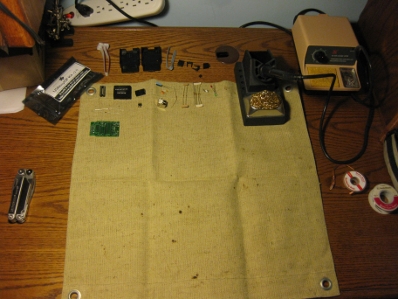
The USBTinyISP comes as a very nice kit, which includes all the component parts including a nice case and well-made PCB.
usbtinyispparts_small.jpg
In the picture, in addition to the included parts, you can see my trusty Xytronic 379 Soldering Station, for which I have nothing but praise (if you think you need one of those classic blue Weller WES51 stations, you really need one of these, its a better station and costs half as much). In the left of the frame you can see my Leatherman Wave, which I cooed about a few days ago. It just happened to be in the picture, I use an ancient pair of thin-profile pliers (now sold as the Xcelite 378, highly, highly recommended) I inherited from my mother when I am working on electronics at home.
usbtinyispalmostdone_small.JPG
I consider myself reasonably competent with a soldering iron, and it took me a little under an hour to go from holding a mailer pouch to programming a chip, with no fuckups in between, which speaks well for the quality of the instructions, the kit, and the thinking that went into them. There are a few interesting quirks in the design; several resistors mount vertically to the PCB, the large electrolytic capacitor is intentionally mounted so it rests on top of the TTL buffer. These are both space-saving measures, and anyone who has ever seen most of the things I throw together on perfboard knows I have a high esteem for nifty tight designs.
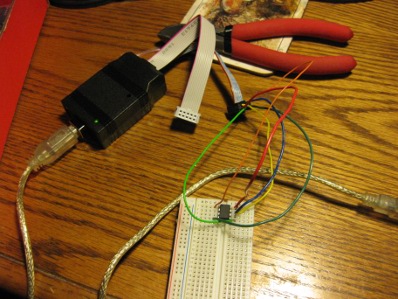
Using the completed programmer is just the same as all the other models of AVR programmer. For software I use AVRDude, since it is well-supported on all common platforms. Below is a shot of my first successful program (or actually, readout) of a chip.
attiny13prog_small.JPG
(closeup)
attiny13bread_small.jpg
That tiny black thing on the breadboard surrounded by the brightly colored wires is one of the aforementioned ATTiny13 chips; I paid $1.95ea for those, and it really is an entirely capable little microcontroller. The incessant march of technological progress never ceases to amaze me. Sometime soon I’ll need to make a little target board that can socket the ATTiny13s and has a plug for the 6-pin connector so I don’t have to muck about with loose wires every time.

Posted in Computers, DIY, Electronics, General, Objects, OldBlog | 1 Comment

Leatherman Wave

So in my Pocket Organizer post the other week I noted I was looking into carrying “one of the smaller multitools.” When I finally went to a outdoorsy type store to fondle multitools instead of teasing myself with them online, the allure of awesome gadgets overcame my concerns about size and weight, and I’ve been carrying a Leatherman Wave (post 2004 model) for the last few weeks. Readers familiar with multitools, or those looking at the preceding link will note that the Wave is not a “smaller” multitool; it is just under 4” long closed, and weighs a little over 8oz. It is however, very, very cool. Now that I’ve been carrying it for a little while, I’m going to go ahead and post a little review. My product links are just to the most convenient page about the item, not an endorsement of whichever site they happen to be to; the official Leatherman page is bad about deep linking.

My major qualifications were a tool that had a straight knife, pilers with wire cutters/strippers, scissors, and a good variety of screwdrivers. I also stipulated that it NOT have a corkscrew, as they are large and tend to get caught on things. The Wave covers all those requirements, and then has some other stuff thrown in, most of which is reasonably welcome, especially the file. People always talk about how nice Leatherman files are; they aren’t lying. That said, I would happily give up the serrated blade and saw (only have the straight blade and file outside-opening, both on one side) to make it thinner. This is not because the tool is too thick, but because I have little use for the extra blades. There is also the retractable lanyard ring. When closed, it keeps the saw from closing smoothly. When open, it protrudes and is completely useless, because the Wave weighs FAR too much to keep on a keychain or lanyard. I noticed there is a similarly useless lanyard ring on the Juice S2 and several other Leatherman models, someone at Leatherman must envision a use for these things. I’m considering taking apart that section of the handle (the whole tool is put together with torx security bits) and just removing it, theres a gap on the other side that looks just like the gap it would leave if removed.

One of the big selling points for the wave is it’s externally opening, locking blades. You definitely can flick the two main blades open with one hand (although it will hurt you if you put your thumb too flat on the thumb hole… one quickly learns not to do that), and it is a neat feature, and fun to operate, but not necessarily something I need. I could see it being important to people used to carrying a folder. The liner locks are very nice; its comforting to know you can’t accidentally snap a blade closed on your fingers, and once you get the motion down they are easy to close one handed.

The workmanship on the Wave is good but not excellent; there is nothing significantly wrong, and there are many thoughtful design features. The minor problems include some visible machining marks, the two sides of the handle aren’t quite equally tensioned, the saw doesn’t always close smoothly (see “lanyard ring” above), and a small number of minor issues of that nature. There are also a couple spots I might consider filing a chamfer onto, particularly near the hinge on the file and saw to make it more comfortable to hold and operate the outside blades. On the thoughtful end of things, the serrated blade has small ridges next to the thumb hole so you can easily distinguish the blades without looking, the handles are designed so that there is a smooth comfortable profile to grip when using the pliers (a common deficiency in Leatherman-style tools), and there is a nifty mechanism that prevents the outside blades from opening while the pliers are open.

The real gem for me is the screwdrivers. Instead of a few fixed screwdrivers, the wave has a pair of bit drivers, one for eyeglass size bits, and one for full size bits, as well as a single fixed flat bit/pry bar. The tool comes with a phillips/flat double ended bit for the eyeglass driver, and a PH1-2 (supposedly fits either)/3/16” double ended bit for the full size driver. Unfortunately, the bits are nonstandard (thinner than a normal 1/4” bit), but one can get an assortment of others from Leatherman (also includes a replacement eyeglass bit), and with patience it is apparently possible to grind standard bits down to fit. The Leatherman bits come on little plastic cards which hold 10 double ended bits, and one card fits neatly in the back of the standard sheaths, allowing one to carry 24 (10 on a card, one in tool, plus eyeglass driver, all double ended) different screwdriver bits in barely any more space or weight. One minor problem with the bit driver is that it is rather stubby, so it won’t fit down for deeply recessed screws or other tight places, but this is inherent to the design. Apparently both this and the nonstandard bits can be solved by buying an extension/adapter (or DIYing the same from a cheap extension). I went for the bit assortment, but not the extension, and carry one card populated with more likely bits.

I actually have both the standard sheaths for the Wave, I originally bought the nylon sheath with the tool, but found it too noisy after a week, and went shopping. I found somewhere that sold the leather model for $5 shipped, and decided to give it a try. Both sheaths have an internal elastic pouch on the inside back that holds a card of bits, and doubled elastic walls on the sides which could also be used as separate compartments for long, thin things (driver extension, AAA flashlight, etc.) Both sheaths also attach either vertically or horizontally to a belt via loops. I expected horizontal wear to be more comfortable, but have found I prefer vertical, just behind my left side. Both sheaths are also designed so one could stuff the opened tool point-first into it. This is another useless feature; I would prefer the sheath be smaller, lighter, and more formed instead. Some differentiating thoughts on the sheaths:
* Leather:
–The Leather is distressingly stiff, and feels like split leather with some sort of finish on both sides, so I’m a little wary of putting conditioners/oils on it to soften it; this problem should take care of itself with use.
– Related to the stiffness, it is rather difficult to get on/off a belt. I’ve been wearing a 1.25” (synthetic) leather belt lately, and I can just barely force it through in the horizontal position.
– It rides a little high on a belt; the top of the closure is maybe 1.5” above the top of the belt in the vertical position.
–The stupid snap rattles when open. Its silent when closed, and not at all loud open, but since I bought the leather sheath to avoid noise it’s mildly annoying.
* Nylon:
– Sounds like a cat being skinned alive every time you open the Velcro.
– Easier to get the tool in/out of
– Easier to take on/off a belt. Still loops not clips, but much more give to the loops than the leather sheath.
– Marginally lighter.
In summary, both sheaths are flawed, but if noise is an issue the leather sheath is a much better choice.

Overall, I’m quite pleased with the Wave. It has worked well for every task I have expected it to since I began carrying it, and feels very satisfying to hold and use. It is a little bigger than I set out to get, but with a little positional trial and error, it’s comfortable enough to wear all the time, which is the point of such a tool. This post is ridiculously long, and if I get inspired I’ll add a couple pictures, but it makes for excellent procrastination.

Posted in General, Objects, OldBlog | 1 Comment

Pocket Organizer

I recently got tired of the collection of junk I carry* punching holes in my pockets, and set out to improve the situation. It turns out there isn’t a good commercial solution to the problem;
“Normal” pen cases like you can get from leather shops and pen companies are designed for protecting a small number of nice (large) writing instruments.
Pocket protectors are rather specifically designed for breast pockets, which I usually don’t have.
So, I went the DIY route, and built a couple prototype shapes out of paper and tape to see what looked right, and pretty quickly settled on a rough design.
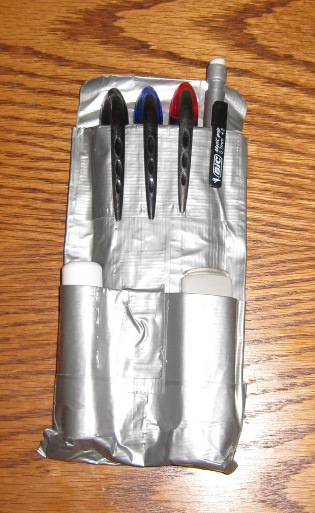
I then built a quick and dirty prototype (below) out of duct tape and paper, which I’ve been subsequently tweaking with use (note the funky seam that separates the flash drive and chap-stick. Added later. With staples.). Eventually, once I get the layout perfected, I think I’d like to build a nice one out of black leather, but we’ll see if that ever happens.
pencase.jpg
Apparently some other (more famous) people are also, to use their phrase “inordinately proud” of their every day carry organizers. Jake von Slatt has a Purse Organizer (via MAKE) that is built in a similar fashion. I am, however, neither man enough nor inclined to give in and carry a purse (that’s what cargo pants and belt clips are for), despite my un-masculine attraction to bags.

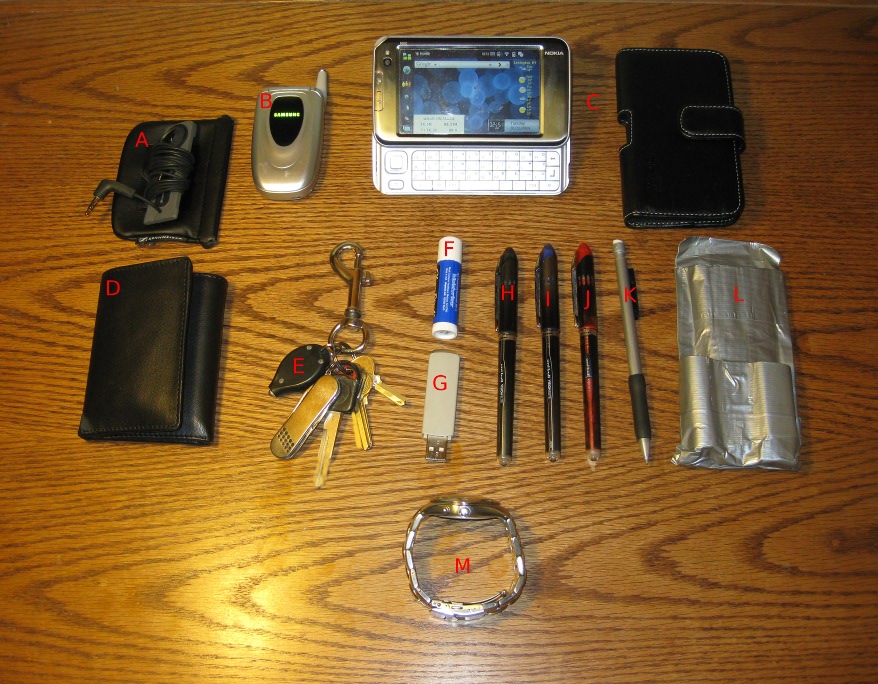
*I ordinarily have the content below attached to me (horribly specific because it has been very consistent for quite some time):
pocketjunkthumb.jpg (linked to larger)

A. Earbuds, currently Sennheiser MX560s (Left cargo pocket)
B. Ancient, indestructable Samsung SPH A660 on STI Mobile (right cargo pocket)
C. Nokia N810 in a PDAir Case (Belt, right front)
D. Wallet, with internal coin pouch (left front pocket)
E. Keys, including mini-tool and light (clipped to right front pocket)
F. Unflavored Chapstick
G. Flash Drive (Currently a well-worn 1GB Sandisk)
H. Black Uniball Vision Elite Extra Fine
I. Blue Uniball Vision Elite Extra Fine
J. Red Uniball Vision Elite Extra Fine (3 colors for a 3 color note taking system)
K. Mechanical Pencil
L. The pen case that prompted this post (right front pocket)
M. Excessive digital+analog watch I’ve been wearing for years.

…and I’ve been considering adding one of the smaller multitools, like a Leatherman Juice S2 to the collection.

Hopefully I’m carrying all this stuff in a way that won’t come back to haunt me like the classic spine problems from carrying a wallet in one’s back pocket thing.

I am apparently not alone devoting so much attention to the junk I carry; there is an entire community devoted to crap people carry with them: enter edcforums (which I have browsed, but haven’t joined. yet.) Then again, “There’s a community on the internet” is in NO WAY an acceptable standard for normalcy or acceptability.

Posted in DIY, General, Objects, OldBlog | 2 Comments