Monthly Archives: November 2025

Solarpunk is happening in Africa

Source: Hacker News

Article note: This is interesting. The technology and manufacturing aspect is super cool. The micro-financing aspect (particularly in contrast with the looming debt bubble crisis 2 in the "developed" world) is a great thought. It conspicuously doesn't talk about maintenance or reliability, which is concerning.
Comments
Posted in News | Leave a comment

Flock haters cross political divides to remove error-prone cameras

Source: Ars Technica

Article note: It should be so legally risky to hold onto that kind of data silo that literally no one will ever willingly do it. Strict liability for misuse.

Flock Safety—the surveillance company behind the country’s largest network of automated license plate readers (ALPRs)—currently faces attacks on multiple fronts seeking to tear down the invasive and error-prone cameras across the US.

This week, two lawmakers, Sen. Ron Wyden (D-Ore.) and Rep. Raja Krishnamoorthi (D-Ill.), called for a federal investigation, alleging that Flock has been “negligently handling Americans’ personal data” by failing to use cybersecurity best practices. The month prior, Wyden wrote a letter to Flock CEO Garrett Langley, alleging that Flock’s security failures mean that “abuse of Flock cameras is inevitable” and that they threaten to expose billions of people’s harvested data should a catastrophic breach occur.

“In my view, local elected officials can best protect their constituents from the inevitable abuses of Flock cameras by removing Flock from their communities,” Wyden wrote.

Read full article

Comments

Posted in News | Leave a comment

How AGI became the most consequential conspiracy theory of our time

Source: Hacker News

Article note: Oh boy, even the ancestral home of AI hype is calling bullshit. MIT was ground zero in the hype cycle and bit by the resulting crash on the first two AI winters in '74 and '87, so when they tell you it's bullshit, believe them, they've been peddling that shit for as long as anyone.
Comments
Posted in News | Leave a comment

Reproduced and Recovered: the First Chinese Keyboard-based MingKwai Typewriter

Source: Hack a Day

Article note: This is a persistent legendary piece of lost technology that it's absolutely _amazing_ turned up (noted at the end of the video: the original prototype surfaced in a literal basement find early this year, in the estate of a former Mergenthaler Linotype engineer). It's super cool to hear some native speakers playing with an electromechnical clone of their own design, and how it relates to later solutions.
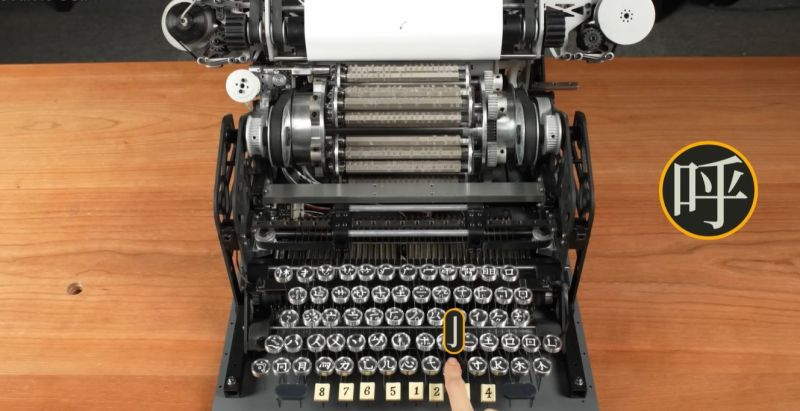
We all know what a typewriter looks like, and how this has been translated directly into the modern day computer keyboard, or at least many of us think we do. Many cultures do not use a writing system like the Roman or Cyrillic-style alphabets, with the Chinese writing system probably posing the biggest challenge. During the rise of mechanical typewriters, Chinese versions looked massive, clumsy and slow as they had to manage so many different symbols. All of them, except for one prototype of the MingKwai, which a group of Chinese enthusiasts have recently built themselves using the patent drawings.

Interestingly, when they started their build, it was thought that every single prototype of the MingKwai had been lost to time. That was before a genuine prototype was found in a basement in New York and acquired by Stanford University Libraries, creating the unique experience of being able to compare both a genuine prototype and a functional recreation.

Considered to be the first Chinese typewriter with a keyboard, the MingKwai (明快打字機, for ‘clear and fast’) was developed by [Lin Yutang] in the 1940s. Rather than the simple mechanism of Western typewriters where one key is linked directly to one hammer, the MingKwai instead uses the keys as a retrieval, or indexing mechanism.

Different rows select a different radical from one of the multiple rolls inside the machine, with a preview of multiple potential characters that these can combine to. After looking at these previews in the ‘magic eye’ glass, you select the number of the target symbol. In the video by the Chinese team this can be seen in action.

Although [Lin]’s MingKwai typewriter did not reach commercialization, it offered the first glimpse of a viable Chinese input method prior to computer technology. These days the popular pinyin uses the romanized writing form, which makes it somewhat similar to the standard Japanese input method using its phonetic kana system of characters. Without such options and within the confined system of 1940s electromechanical systems, however, the MingKwai is both an absolute marvel of ingenuity, and absolutely mindboggling even by 2020s standards.

Posted in News | Leave a comment

AMD to enter ARM market with new “Sound Wave” APU

Source: OSNews

Article note: Wasn't this the plan a couple years after they ate ATI in like 2014? I suspect they're partly going after the midrange handheld market here, they did very well with the Steam deck, most of its competitors are running like Snapdragon and Dimensity ARM parts.

AMD is expanding its processor portfolio beyond the x86 architecture with its first ARM-based APU, internally known as “Sound Wave.” The chip’s existence was uncovered through customs import records, confirming several details about its design and purpose. Built with a BGA-1074 package measuring 32 mm × 27 mm, the processor fits within standard mobile SoC dimensions, making it suitable for thin and light computing platforms. It employs a 0.8 mm pitch and FF5 interface, replacing the FF3 socket previously used in Valve’s Steam handheld devices, further hinting at a new generation of compact AMD-powered hardware.

↫ Hilbert Hagedoorn at The Guru of 3D

It only makes sense for AMD to enter the market for ARM SoCs, as it’s a whole section of the processor market they’re not tapping into. Even if they don’t manage to compete with the best ARM processors out there, they can still serve the mid and lower end just fine.

Posted in News | Leave a comment

We Won’t Be Talking About GenAI in 2035, and That’s a Problem

Source: ACM Interactions

Article note: From the community who almost subsumed itself into "Ubiquitous Computing" 15 years ago; glimmers of awareness about the dangers of coercive technology controlled by third parties not users.

  In this feature, we apply a decennial perspective to discuss the interweaving of technology, everyday practices, and societal infrastructures. We ask what happens when technologies become so embedded in everyday life that we stop talking about them and who gets left out in this process. The occasion of the Aarhus decennial conference 2025 made us look at the intersection of...

Posted in News | Leave a comment