Article note: ... but totally let game companies install rootkits on your computer for a marginal reduction in people cheating at video games.
Game company 2K has warned users to remain on the lookout for suspicious activity across their accounts following a breach last month that allowed a threat actor to obtain email addresses, names, and other sensitive information provided to 2K's support team. From a report: The breach occurred on September 19, when the threat actor illegally obtained system credentials belonging to a vendor 2K uses to run its help desk platform. 2K warned users a day later that the threat actor used unauthorized access to send some users emails that contained malicious links. The company warned users not to open any emails sent by its online support address or click on any links in them. If users already clicked on links, 2K urged them to change all passwords stored in their browsers. On Thursday, after an outside party completed a forensic investigation, 2K sent an unknown number of users an email warning them that the threat actor was able to obtain some of the personal information they supplied to help desk personnel.
Article note: Dang. Politicians keep delivering on long-held issues used to rile up the base but never handled. This one will probably go better for all involved than the dog-who-caught-the-car with overturning Roe.
Enlarge/ The morning fog leaves a layer of dew on cannabis rows in Petrolia, California, August 3, 2022. (credit: Getty | The Washington Post)
President Biden on Thursday announced that he is pardoning all prior federal offenses of simple marijuana possession and encouraged state governors to do the same for state offenses. He also directed federal officials to review how marijuana is classified under the Controlled Substances Act.
"There are thousands of people who have prior federal convictions for marijuana possession, who may be denied employment, housing, or educational opportunities as a result," Biden said in a statement. "My action will help relieve the collateral consequences arising from these convictions."
The blazing announcement means that all prior charges, convictions, and not-yet-prosecuted offenses will be pardoned. The Justice Department will set up an administrative process for those affected to obtain a certificate of pardon.
Article note: Dang.
It's a $5000 platform dev machine, and there are legitimate security concerns about Chinese-state-interest-all-the-way-down systems, but that is a shockingly credible RISC-V "real PC" class machine, years ahead of any reasonable expectation.
The TH1520 is born out of the Wujian 600 platform unveiled by Alibaba in August 2022, and is capable of running desktop-level applications such as Firefox browser and LibreOffice office suite on OpenAnolis open-source Linux-based operating system launched by Alibaba in 2020.
This is a very important first step into ‘normal’ computing for RISC-V, but availability and pricing are, for now, major barriers here. I’d love to get my hands on one of these, but at these prices, that’s a massive ask.
Article note: It really is funny how "A well-documented known good system with well-established software stack" (even an aging, somewhat feeble one with the history of "shifty power circuit" "shifty serial implementation" etc.) is so desirable that decent sized niches of the industry started depending on them instead of rolling their own... so thoroughly that you can't actually get them for their original intended education/experimentation purpose right now.
I wish one of the other SOC vendors offering a reasonable part with a couple Cortex-A7x cores would get their shit together with a reference board and the software and documentation front, it's absurd that Broadcom - who are traditionally assholes about docs and code - have entrenched simply by only being _moderately_ obstructive to their user base. Rockchip keeps getting close but their software stack is a little too garbage.
Shortages for lots of tech components, including things like DDR5 and GPUs, have eased quite a bit since the beginning of 2022, and prices have managed to go down as availability improves. But that reprieve hasn't come for hobbyists hoping to get a Raspberry Pi, which remains as hard to buy today as it was a year ago.
The most recent update on the situation comes from Raspberry Pi founder Eben Upton via YouTuber Jeff Geerling—Upton told Geerling that Pi boards are subject to the same supply constraints since the last time he wrote a post about the situation in April. Around 400,000 Pi boards are still produced per month, and some of these are being earmarked to be sent out to consumer retail sites. But Upton says that most of these are still being reserved for and sold to commercial customers who rely on Pi boards to run their businesses.
In short, the update is that there is no update. Upton said in April (and nearly a year ago, when the company raised the price for a Pi board for the first time) that the Broadcom processors at the heart of older Pi boards have been particularly difficult to source, but that high demand had been just as big an issue. Demand for Pi boards increased during the pandemic, and there was no more manufacturing capacity available to meet this demand. Upton said a year ago that there were "early signs that the supply chain situation is starting to ease," but backed-up demand could still explain the short supply even if the Pi's components have gotten easier to buy.
Article note: Ah, new-internet entities trying to make money off of old-internet content.
Maybe they'll ad-infest it so badly that everyone will remember hosting static content is super cheap and re-decentralize.
Article note: As a happy owner of an Anbernic RG351p running AmberElec, the "Android" part isn't important, and frankly the "streaming" part isn't that important either, but a convenient device with a physical controller that can emulate our now-vast cultural heritage of "older" video games is a lovely thing. Especially in the sub $200 range.
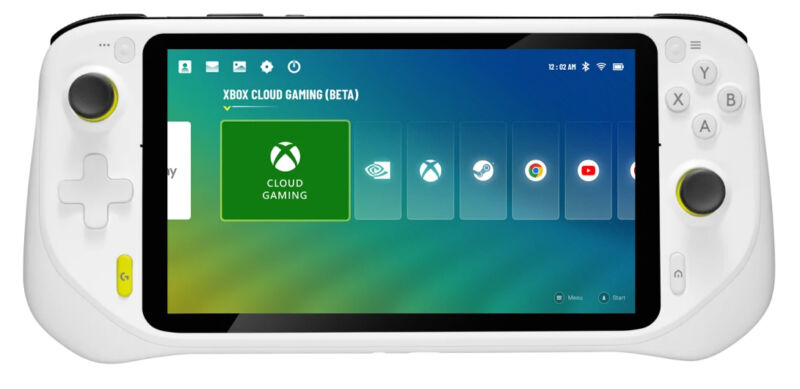
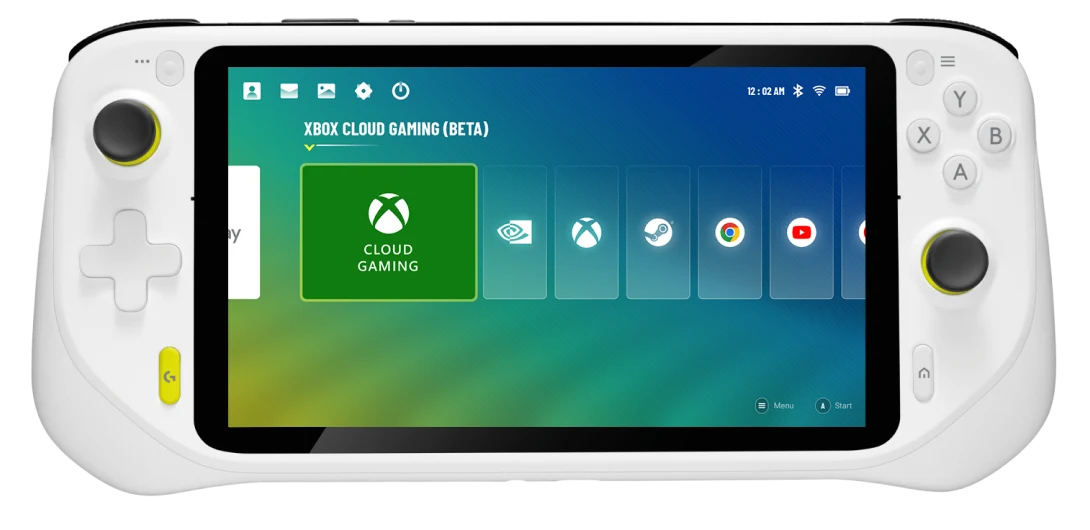
Enlarge/ Let's see: Xbox Cloud Gaming, Nvidia Geforce Now, Xbox again, and Steam Link. That's all the cloud streaming services, right? Nothing's missing. (credit: Logitech)
It's not every day that you see the attempted birth of an entirely new category of video game hardware. But it feels like that's what we're seeing this month with the announcement of the Logitech G Cloud and the Razer Edge 5G handheld gaming systems.
While these devices (and somewhat similar emulation-focused handhelds like the AYN Odin) have their differences, they share Qualcomm SnapDragon internals, an Android-based OS, and vaguely Switch-like hardware designs. And while these devices can natively run games designed for Android phones (for whatever that's worth), the main focus seems to be streaming portable versions of high-end console and PC games through various cloud-gaming providers or in-home streaming options.
It's too early to know how well these handhelds will serve their stated purpose, or how much actual market demand there is for dedicated portable devices that primarily play games hosted on remote servers or platforms. Still, we can't help but compare and contrast this new hardware design trend with the last major (failed) attempt to create a new category of gaming hardware: the microconsole.
Article note: Least surprising announcement ever.
I got one of the freebie controller + Chrome Cast Ultras they offered to YouTube Premium customers, half to play with it and half because I expected it to be short-lived and turn into a collector's item. The system is a _staggering_ technical accomplishment with tons of (unnecessary) complexity... and basically no realistic use-case, especially since everyone suspected it would get shut down in short order.
Impressive (and surprising) that they're refunding everyone out instead of leaving them in the lurch - maybe the bean-counters determined the liability for the rug-pull would cost more than the refunds since they were actively denying shutdown as recently as July.
Enlarge/ Stadia is circling the drain. (credit: Aurich Lawson)
The moment everyone saw coming is finally happening. Google has officially confirmed that it's killing Stadia, the company's troubled game-streaming service. Phil Harrison announced today in a blog post that Stadia "hasn't gained the traction with users that we expected so we’ve made the difficult decision to begin winding down our Stadia streaming service." Stadia will be laid to rest on January 18, 2023.
The good news is that the true Armageddon situation for Stadia customers is not happening. Google is issuing refunds, which will save dedicated Stadia players from losing potentially hundreds of dollars in lost games. The post says: "We will be refunding all Stadia hardware purchases made through the Google Store, and all game and add-on content purchases made through the Stadia store." That notably excludes payments to the "Stadia Pro" subscription service, and you won't get hardware refunds from non-Google Store purchases, but that's a pretty good deal. The controllers are still useful on other platforms, too.
Stadia's technology will live on as a Google Cloud product called "Immersive Stream for Games." Google has made some headway pitching the feature as a way to run games on underpowered devices, like Peloton fitness equipment.
Article note: The fact that the norm is platform churn that requires constant adjustment, security issues that require constant fixes, feature maximialism that requires constant addition, and UI hipster-ism that requires constant shuffling is so much the norm that it is an expectation is a serious indictment against the state of computing.
Article note: Every now and then I investigate the personal health data gadget market looking for something that you can reliably use to collect basic metrics (and extract that data from) without going through some third party on the Internet for no good reason.
There are some devices hacked by the GadgetBridge folks, but it seems like the entire market is built around sucking every user's data into the manufacturer's servers.
Google's acquisition of Fitbit closed in early 2021, but we haven't seen much in the way of changes yet. 9to5Google spotted a big upcoming change posted on Fitbit's help site: account migrations! A new Fitbit help page has outlined the plan for the coming Google account migration. If this goes anything like the Nest account migrations (done by the same Google Hardware division), Fitbit users are in for a wild ride.
Google's support page says, "We plan to enable use of Fitbit with a Google account sometime in 2023" and that at that point "some uses of Fitbit will require a Google account, including to sign up for Fitbit or activate newly released Fitbit devices and features." That means optional account migrations for existing users in 2023. Google also says, "Support of Fitbit accounts will continue until at least early 2025. After support of Fitbit accounts ends, a Google account will be required to use Fitbit. We'll be transparent with our customers about the timeline for ending Fitbit accounts through notices within the Fitbit app, by email, and in help articles."
The merging of accounts will, of course, mean that Google gets your health data. Google says that "you’ll need to consent to transfer your Fitbit user data from Fitbit to Google" and that "Google will then provide you with Fitbit under Google’s Terms of Service, Privacy Policy, and binding commitments for Fitbit." Part of those EU commitments, which Google chose to apply to the whole world, is that "Google will not use Fitbit health and wellness data for Google Ads."
The world is full of things that upset people. But most of us deal with it and move on and don’t try and burn the planet down. There is no right in the world not to be offended. That right simply doesn’t exist