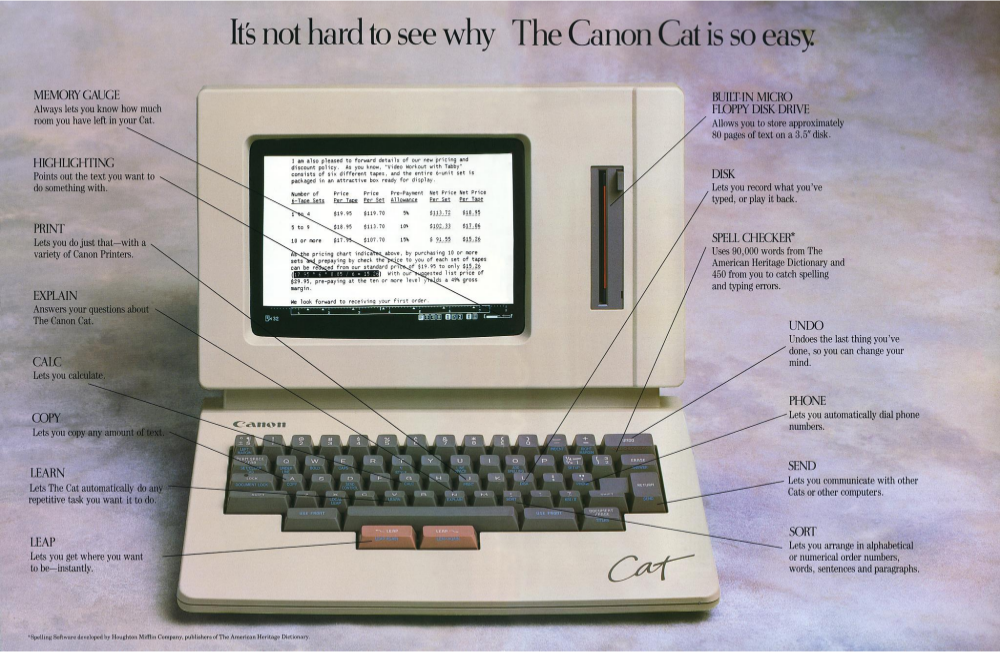
I’m not sure why there has been a spate of tech news artcles about the Canon Cat recently, but it’s really refreshing to see. I assume it started because someone spotted this nice document dump, and the tech news world is an echo chamber.
Many of the articles note that the manuals and such come with (mostly) complete circuit designs, but they miss the other interesting bit of technical openness – Cats were running a totally introspective user accessible software stack written in a dialect of Forth. In addition to having a UI that is still a popular example for application specific computing devices, it was also user programmable/modifiable almost down to the hardware. I’m not a fan of Forth, but it demonstrates that 1. It is possible to make an embedded computer programmable without interfering with its UI model, and 2. It is possible to design introspective systems which are usable, which are right in line with what I want to be doing with myself next, and totally out of line with current trends in computing. It brings to mind Alan Kay‘s work, or a more reasonable LISP machine.
The other reason I’m fascinated by the Cat is that it manages to make a completely modeless text editing system, and its development spawned several papers (in the linked documents) on the topic. I despise implicit modality in user interfaces (this is why, despite having all kinds of wonderful features, the traditional progammer’s editors just end up making me furious), and good through theoretical and case studies supporting that stance are a beautiful thing.
That dump is slightly different collection of Canon Cat materials that I put together when I was curious after reading The Humane Interface a couple years back. I’m still integrating the collections, but there seems to be some different stuff in each – piles of arbitrary format documents are hard to diff, especially when there is no name correspondence and some are binary formats. I think there may be enough material in the various available sources that, given access to an operable CAT and a reasonable digital lab, it would only be a large 10s/small 100s of man hours of work to emulate or even hardware simulate one.
I’ve never (actually, I think I ran into one as a kid but did’t know what it was at the time) had a chance to play with a real Canon Cat, and owning one would be a mixture of all the standard problems in owning vintage computing stuff – they’re expensive and collectible, and like most computers of the era, bulky and fragile, and they require problematic media… but I would still probably get one if I had the chance for a reasonable price, because they did so many interesting things right. More and more I think CS/EE programs should include (probably just as an elective) proper History of Computing courses – if my intended life pattern continues, I may even get to teach one for a while. I think it would be a blast for all involved.
