Article note: This is a good deep dive.
Lot of (especially younger who didn't live with them) people seem to misunderstand how things render on CRTs.
It's understandable, reasoning about aliasing in all its forms (signals, memory, graphics - same word because of mathematical similarity, though we tend to think of them differently) is always tricky even for experts.
Article note: Now I'm curious if this is going to be the out for all the bullshit on APK signing.
The sophisticated users will just run their preferred software in a Linux VM, and ignore/distrust the host android system to the greatest degree possible, like we've been forced to do with basebands already. And everyone else will get herded into the coercion engine to drown under a flood of ads and propaganda.
I guess it depends how good the performance and feature access for the hosted Linux system is - if the tooling gets where I can just use an Android system as a bootstrap for Plasma Mobile on Debian or whatever, and put the few things I want running on the Android side in their own little jails, those terms might be acceptable.
Article note: Always like to see innovations in the weird keyboard space.
I don't tend to love 10-key chorders, but the glove implementation and handling of sequential behavior is cool.
Article note: Why the _fuck_ were they _retaining_ IDs?
It's bad enough that entities have started demanding them to comply with various poorly-through-out "Won't Someone Think of the Children" laws, but retaining the IDs after verifying is either malicious or actively irresponsible.
Article note: Nvidia has been propping up most of the AI bubble with this kind of circular investment scheme, it's curious that so many commentators are choosing to admit that's what is going on now that AMD is doing it as well.
Article note: I hope they get a real sourced answer, because every time I do logic voltage lectures I wonder how 5V was actually chosen, and I'm not good enough at analog electronics to be sure of my own reasoning.
I commented my best shot:
The earlier (1963) Sylvania SUHL family of TTL IC parts was also Vcc=5V, and it appears to have been selected to get +1/-1.5V of noise immunity and swing of >3V as a “nice round numbers” thing with the particular topology and transistors they were using.
That’s as close to an answer as I’ve found when I’ve gone looking in the past.
Why 5 and not 4.7 (E series preferred number ) or the like I’ve never found an answer with a period source for.
There’s an interview with Tom Longo who did the original TTL IC designs ( https://archive.computerhistory.org/resources/access/text/2016/12/102762590-05-01-acc.pdf ) that refers to the talk his group gave describing those first designs ( https://ieeexplore.ieee.org/abstract/document/1473619 ) but… AFIK full text doesn’t exist, just the abstract for the talk, and it’s the most likely place for a true traceable first-cause to be, if indeed there is a surviving record.
The familiar five volts standard from back in the TTL days always struck me as odd. Back when I was just a poor kid trying to cobble together my first circuits from the Forrest Mims Engineer’s Notebook, TTL was always a problem. That narrow 4.75 V to 5.25 V spec for Vcc was hard to hit, thanks to being too poor to buy or build a dedicated 5 V power supply. Yes, I could have wired up four 1.5 V dry cells and used a series diode to drop it down into range, but that was awkward and went through batteries pretty fast once you got past more than a few chips.
As a hobbyist, the five volt TTL standard always seemed a little capricious, but I strongly suspected there had to be a solid reason behind it. To get some insights into the engineering rationale, I did what anyone living in the future would do: I asked ChatGPT. My question was simple: “How did five volts become the standard voltage for TTL logic chips?” And while overall the answers were plausible, like every other time I use the chatbot, they left me wanting more.
Circular Logic
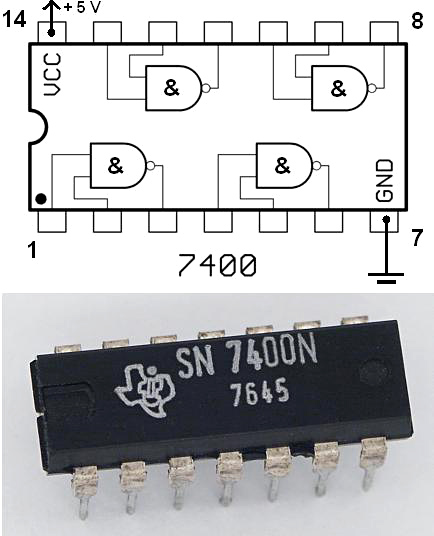
TTL, 5 volts and going strong since 1976 (at least). Source: Audrius Meskauskas, CC BY-SA 3.0.
The least satisfying of ChatGPT’s answers all had a tinge of circular reasoning to them: “IBM and other big computer makers adopted 5 V logic in their designs,” and thanks to their market power, everyone else fell in line with the five volt standard. ChatGPT also blamed “The Cascade Effect” of Texas Instruments’ standardization of five volts for their TTL chips in 1964, which “set the tone for decades” and forced designers to expect chips and power supplies to provide five volt rails. ChatGPT also cited “Compatibility with Existing Power Supplies” as a driver, and that regulated five volt supplies were common in computers and military electronics in the 1960s. It also cited the development of the 7805 linear regulator in the late 1960s as a driver.
All of this seems like nonsense, the equivalent of saying, “Five volts became the standard because the standard was five volts.” What I was after was an engineering reason for five volts, and luckily, an intriguing clue was buried in ChatGPT’s responses along with the drivel: the characteristics of BJT transistors, and the tradeoffs between power dissipation and speed.
The TTL family has been around for a surprisingly long time. Invented in 1961, TTL integrated circuits have been used commercially since 1963, with the popular 7400-series of logic chips being introduced in 1964. All this development occurred long before MOS technology, with its wider supply range, came into broad commercial use, so TTL — as well as all the precursor logic families, like diode-transistor logic (DTL) and resistor-transistor logic (RTL) — used BJTs in all their circuits. Logic circuits need to distinguish between a logical 1 and a logical 0, and using BJTs with a typical base-emitter voltage drop of 0.7 V or so meant that the supply voltage couldn’t be too low, with a five volt supply giving enough space between the high and low levels without being too susceptible to noise.
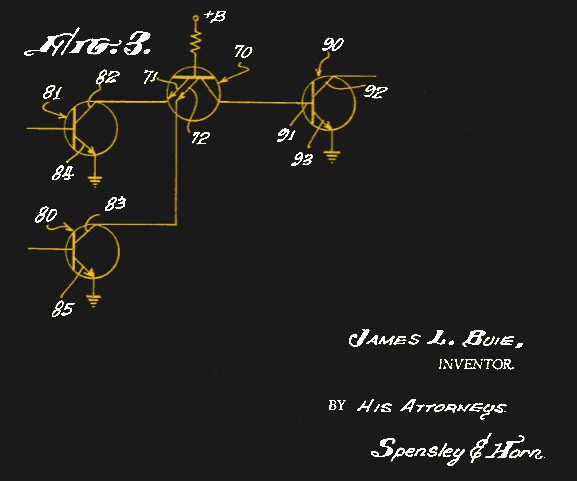
The 1961 patent for TTL never mentions 5 volts; it only specifies a “B+”, which seems like a term held over from the vacuum tube days. Source: U.S. Patent 3283170A.
But, being able to tell your 1s and 0s apart really only sets a minimum for TTL’s supply rail. Why couldn’t it have been higher? It could have, and a higher Vcc, like the 10 V to 15 V used in emitter-coupled logic (ECL), might have improved the margins between logic levels and improved noise immunity. But higher voltage means more power, and power means heat, and heat is generally frowned upon in designs. So five volts must have seemed like a good compromise — enough wiggle room between logic levels, good noise immunity, but not too much power wasted.
I thought perhaps the original patent for TTL would shed some light on the rationale for five volts, but like most inventors, James Buie left things as broad and non-specific as possible in the patent. He refers only to “B+” and “B-” in the schematics and narrative, although he does calculate that the minimum for B+ would be 2.2 V. Later on, he states that “the absolute value of the supply voltage need be greater than the turn-on voltage of the coupling transistor and that of the output transistor,” and in the specific claims section, he refers to “a source of EMF” without specifying a magnitude. As far as I can see, nowhere in the patent does the five volt spec crop up.
Your Turn
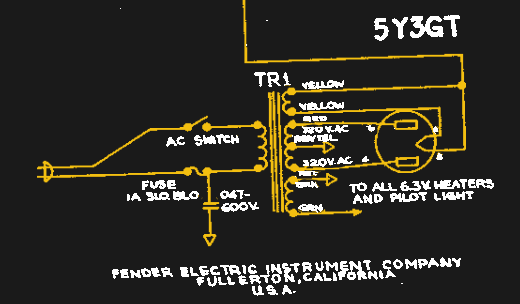
The Fender “Champ” guitar amp had a rectifier tube with a 5-volt filament. Perhaps TTL’s Vcc comes from that? Source: SchematicHeaven.net.
If I were to hazard a guess, the five volt spec might be a bit of a leftover from the tube era. A very common value for the heater circuit in vacuum tubes was 6.3 V, itself a somewhat odd figure that probably stems from the days when automobiles used 6 V electrical systems, which were really 6.3 V thanks to using three series-connected lead-acid cells with a nominal cell voltage of 2.1 V each.
Perhaps the early TTL pioneers looked at the supply rail as a bit like the heater circuit, but nudged it down to 5 V when 6.3 V proved a little too hot. There were also some popular tubes with heaters rated at five volts, such as the rectifier tubes found in guitar amplifiers like the classic Fender “Champ” and others. The cathodes on these tubes were often directly connected to a dedicated 5 V winding on the power transformer; granted, that was 5 V AC, but perhaps it served as a design cue once TTL came around.
This is, of course, all conjecture. I have no idea what was on the minds of TTL’s designers; I’m just throwing out a couple of ideas to stir discussion. But what about you? Where do you think the five volt TTL standard came from? Was it arrived at through a stringent engineering process designed to optimize performance? Or was it a leftover from an earlier era that just happened to be a good compromise? Was James Buie an electric guitarist with a thing for Fender? Or was it something else entirely? We’d love to hear your opinions, especially if you’ve got any inside information. Sound off in the comments section below.
Article note: faaaaack, TTRSS is being discontinued.
It's open source and self hosted, so I can keep running my instance until I have time to deal with it, but I should probably find a migration plan, I'm super dependent on it.
Article note: As much as I like the Synology appliances I've worked with, I was really puzzled by this, the whole proposition of Synology is being an optimized (on price-via-economy-of-scale and polish) alternative to DIYing a Linux NAS with a PC or ARM SBC for the moderately-technical sub-enterprise storage market.
Their software has been getting a little worse (and increasingly ancient, I don't know what out-of-tree patches they make, but recent DSM versions are running like decade-old kernels), then ...this shit with the vendored hard drives... and they wonder why their market collapsed?
Article note: This is probably not good.
Qualcomm's record with sustained community engagement is not good, with open source is not good, etc. Just on the basis of the Arduino platform targeting a large variety of target micros from a large variety of vendors, and having one of that set of vendors in control of the platform is likely to introduce unfortunate biases in compatibility and resource decisions.
It was good while it lasted, I guess.
Arduino will retain its independent brand, tools, and mission, while continuing to support a wide range of microcontrollers and microprocessors from multiple semiconductor providers as it enters this next chapter within the Qualcomm family. Following this acquisition, the 33M+ active users in the Arduino community will gain access to Qualcomm Technologies’ powerful technology stack and global reach. Entrepreneurs, businesses, tech professionals, students, educators, and hobbyists will be empowered to rapidly prototype and test new solutions, with a clear path to commercialization supported by Qualcomm Technologies’ advanced technologies and extensive partner ecosystem.
Qualcomm’s track record when it comes to community engagement, open source, and long-term support are absolutely atrocious, and there’s no way Arduino will be able to withstand the pressures from management. We’ve seen this exact story play out a million times, and it always begins with lofty promises, and always ends with all of them being broken. I have absolutely zero faith Arduino will be able to continue to do its thing like it has.
Arduino devices are incredibly popular, and it makes sense for Qualcomm to acquire them. If I were using Arduino’s for my open source projects, I’d be a bit on edge right now.
Article note: We really need to start making some distinctions separating algorithmic feeds (which are pure brainrot and propaganda) and participating in society.
It's _really good_ for young people to encounter enthusiast communities and professions and communicating-like-adults online. Algorithmic feeds are almost certainly bad for ...all of us.
The Danish government wants to introduce a ban on several social media platforms for children under the age of 15, as Prime Minister Mette Frederiksen announced Tuesday. From a report: "Mobile phones and social media are stealing our children's childhood," she said in her opening speech to the Danish parliament, the Folketing. "We have unleashed a monster," Frederiksen said, noting that almost all Danish seventh graders, where pupils are typically 13 or 14 years old, own a cellphone.
"I hope that you here in the chamber will help tighten the law so that we take better care of our children here in Denmark," she added. However, Frederiksen did not give further details on what such a ban would entail, nor does a bill on an age limit appear in the government's legislative program for the upcoming parliamentary year.