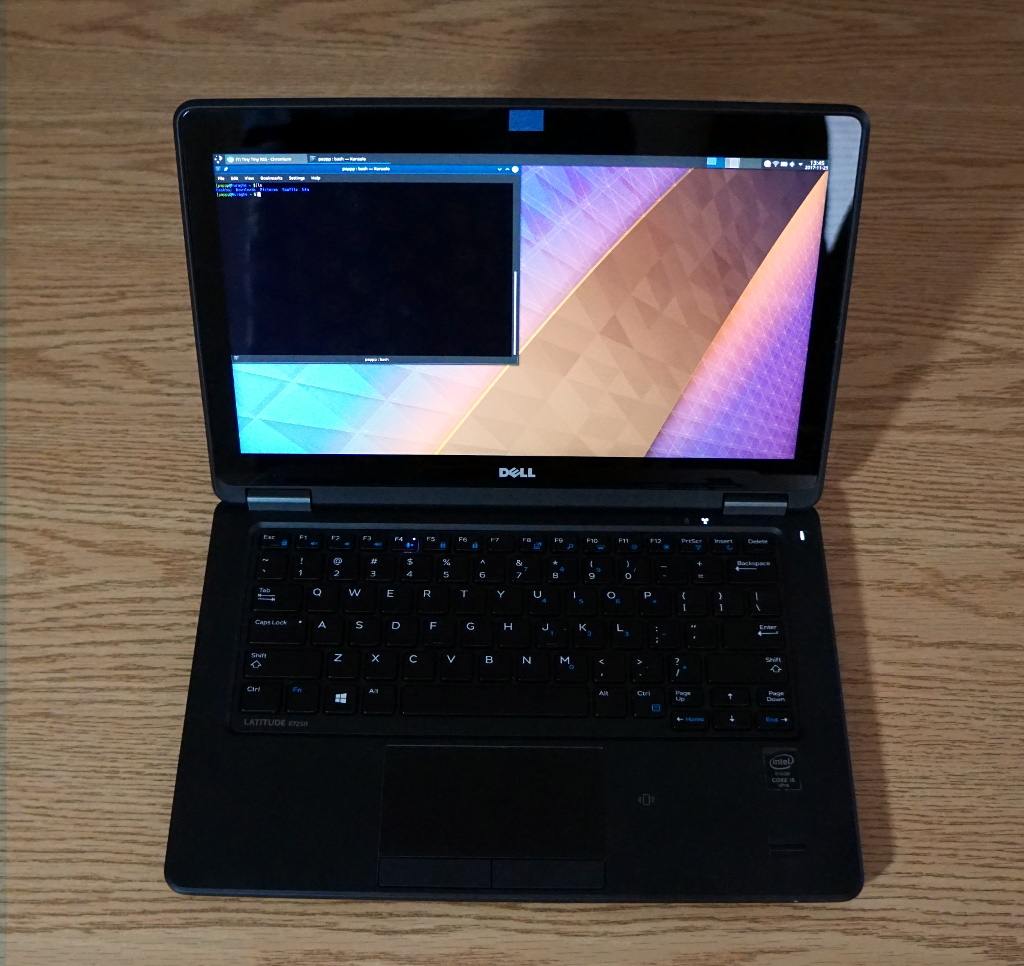
I found a forum.thinkpads thread while looking into another touchpad issue recently, and learned two important facts:
- The bumpy touchpad texture I never loved that had worn off my T510 is just a sticker.
- Those stickers are replaceable.
I found a forum.thinkpads thread while looking into another touchpad issue recently, and learned two important facts:
I finally finished danah boyd’s recent book It’s Complicated, and It’s one of the best pieces of non-fiction I’ve read in years.
I always feel there is a dramatic shortage of people equipped with both the appropriate formal methods in the social sciences and technological sophistication to make credible, meaningful, observations on technologically mediated culture. danah is reliably the best of them; I’ve read quite a number of her papers and articles, and the book is fuller and more readable than either.
Almost every passage roughly follows a pattern of statement, with attribution, relevant anecdote from original research, message. It is meticulously referenced (roughly a quarter of the book’s volume is appendices and references), which comes off a little academic, but anything less conscientious would end up being the kind of prognostication much of the book is trying to correct, and the actual writing comes off as far more pleasant and readable than it sounds. It is occasionally repetitive, but every time the repetition asserted itself, it was clearly a case of “I keep saying this over and over and they just don’t get it” rather than any sort of sloppy writing.
Occasionally, there are wistful references to the internet I grew up on; the author is about a decade older than I am, and grew up on the leading edge of the internet I was on the trailing edge of. The one where Ender’s Game (Locke and Demosthenes plot), True Names, and Ready Player One can happen, before the carpetbaggers arrived in force and (to quote the book) “When teens go online, they bring their friends, identities, and network with them.” situation asserted itself. I’m pretty sure my generation killed that different identity system, and buried it behind us (One of her early notable efforts was documenting the introduction of Friendster, which was in some ways the beginning of the end).
At least once a chapter, I found myself in vigorous agreement with some message being presented, enough that if there were people around when I was reading they could tell. The vast majority of the observations, while based in research into teens, also seem to generalize reasonably well to the behavior of most populations. The only unfortunate part is that I suspect the people making decisions about youth and technology who desperately need to hear what it has to say are not going to be the ones to read it.
Note that there is a PDF copy right on the author’s site, so even if you don’t want to go buy it, you can legitimately peruse it for free.
I’ve posted before on the slow restoration of my old 201-2 and its cabinet, last time I noted that my cabinet’s swing-arm wouldn’t auto-deploy, which prompted some discussions with other folks about the mechanism. One of those other pieces of input was someone kind enough to tip me off in the comments of my last note about this that there were a couple sets on ebay, which I looked at for details, then ended up buying one of for $22 shipped. I really only needed the lower pin and spring, but the spares are nice. This is what the seller pictured, and the light and camera are better than mine, so I’ll just use their picture, because it was well packed and exactly as described:
I now have mine working and have detail photos and measurements from the process that should make it easier for others to figure these things out. It’s actually a really simple mechanism, the following two pictures are pretty much all you need to know about how it goes together and works.
Continue reading
Continuing my habit of posting before and after notes on my courses, after notes for Spring 2014.
Continue reading
The Inspiron 11-3000 I’ve been carrying around developed a rattle the other day, and today I decided to open it up.
Continue reading
I’ve recently added a couple tools to my standard set, and have at least a 4x improvement in the safety of my data by doing so.
The process was complicated a bit because I’ve become very sensitive about only depending on FOSS tools (ex:As much as I like SublimeText2, I stopped using it because it once demanded to be updated before it would run.), but frankly I think that constraint produced better results than I would have reached without it. Because it was something of a hunt, I’d like to recommend the particular tools I settled on, in particular are KeepassX, Attic, and Seafile, described individually below.
Continue reading

I noticed I was scuffing up the not-my-laptop that I’ve been carrying, so I did a little “30 minute” sewing project (that actually took over an hour because I’m apparently retarded) after I burnt out on other things for the evening.
The intention is a little sleeve that will be snug enough to retain the laptop, and let me slide it between [note]books, etc. in a bag. That means a little long, with thick hems on the open end for retention, and no flaps, fasteners, or protrusions to hang up on other things in the bag.
Basically, I measured the wrapped length and width of the machine (to accommodate for thickness), cut a piece of fabric I had around to the full wrapped long dimension (+1.75″ for hems and clearance) and half the wrapped short dimension (+1″ for seams), hemmed the short ends, folded it in half, ran a seam down the sides, half-assed wrapped the first 2″ of each side seam, and called it adequate.
Downside:
Using my venerable old machine always makes me feel like it and 3 generations of my family are judging me when I do something inept or half-assed on it, which probably makes my projects better.
I think I’m satisfied. I’d like it to be just a hair snugger, but the fit is pretty good and snugger would have run the risk of finishing then not being able to get the machine in. I think I want to make some kind of companion pouch for the power brick, but I’m not sure how, an attached pocket would ruin the slip-between-things-in-my-bag functionality.
The KAOS lab recently bought a fleet of five Inspiron 11 3000 3138[PDF Warning] (Celeron N2815/4GB/500GB)laptops. They’re tiny little machines with 8 hour claimed battery lives, they’re pretty cute and sort of obstinate.
I borrowed one to play with, notes:
Continue reading
Some years ago the KAOS lab bought a number of Netgear WNR3500L routers to use as network glue. A pair of them have been in constant service since 2011 in the lab and machine room, and both of those died in the last two weeks. I’ve finally satisfactorily tracked down the culprit, and figure it’s worth a quick write up.
The WNR3500L is a bit of a false-promise machine; it was sold as an “open router” with excellent community firmware support, but it has some pretty extensive blobs that mean it really only runs versions of DD or Tomato with a small range of 2.6 kernels.
I initially just swapped the first one to die out for a spare (which happened to be flashed with Tomato instead of DD, it was an experiment when they were first set up), and reloaded most of the settings by hand (we failed to save or document many of the settings elsewhere. Our fault.) until I had time to investigate. When the second one died, it became urgent.
Conveniently, the WNR3500L has a 3.3V RS-232-like serial port (115200/8/n/1) under an easily removed panel, retained by one small torx screw/pin thing (Both are out in the picture while I was figuring out which side was which).
This leads to another victory for the Bus Pirate. Any 3.3V compatible UART adapter would work, but the bus pirate has much nicer cables for this sort of thing. In retrospect, those headers are correctly sized to just plug the female harness ends directly, but I used clips out of habit.
It turns out they were booting right up with only warnings, but the configuration was sufficiently garbled that neither the WLAN nor the Ethernet ports were coming up. I blew the first one’s settings away (note: at least on the old version these were running, reboot TWICE after clearing the NVRAM to get back to a consistent state: the first time it writes default values, the second time it boots cleanly). With the software-only nature of the problem established, I took more time to investigate the second one, at which point…
nvram show
[1310 lines excluded]
size: 32782 bytes (-14 left)
Well, There’s Your Problem.
Turns out the tiny little log fields for monthly traffic statistics filled up the nvram and were causing configuration corruption, and thus failures.
There are some forum threads and bug reports on the matter, and it was fixed about two years ago with a test to prevent writing past the end of the file, a default setting to automatically delete traff logs after 12 months, and various other enhancements. Now that we’re up and running again it isn’t desperate, but it looks like there is a DD release from mid-2013 with the fixes applied that still supports these things, and they are probably due to be re-flashed to keep this from happening again.
Lessons:
Other notes: