Source: Hacker News
Article note: This is are just CSIPs (Cementitious/Composite Structural Insulated Panels)? It's really good tech that I'd love to see more of in use, but not exactly a revolutionary new technology.
Comments Source: Hacker News
Source: The Verge - All Posts

Textbook publisher Pearson suggests blockchain tech could let it take a cut of secondary textbook sales, capturing a section of the book market that’s so far escaped it. As quoted by Bloomberg, Pearson CEO Andy Bird believes non-fungible tokens, or NFTs, could help publishers make money off textbook resales, although he stopped short of describing concrete plans.
“In the analog world, a Pearson textbook was resold up to seven times, and we would only participate in the first sale,” said Bird after the company announced its latest quarterly earnings this week. “The move to digital helps diminish the secondary market, and technology like blockchain and NFTs allows us to participate in every sale of that particular item as it goes through...
Source: Hacker News
Source: Hacker News
Source: AnandTech Articles
It appears that the end may be in sight for Intel’s beleaguered Optane memory business. Tucked inside a brutal Q2’2022 earnings release for the company (more on that a bit later today) is a very curious statement in a section talking about non-GAAP adjustments: In Q2 2022, we initiated the winding down of our Intel Optane memory business. As well, Intel’s earnings report also notes that the company is taking a $559 Million “Optane inventory impairment” charge this quarter.
Beyond those two items, there is no further information about Optane inside Intel’s earnings release or their associated presentation deck. We have reached out to company representatives seeking more information, and are waiting for a response.
Taking these items at face value, then, it would seem that Intel is preparing to shut down its Optane memory business and development of associated 3D XPoint technology. To be sure, there is a high degree of nuance here around the Optane name and product lines here – which is why we’re looking for clarification from Intel – as Intel has several Optane products, including “Optane memory” “Optane persistent memory” and “Optane SSDs”. None the less, within Intel’s previous earnings releases and other financial documents, the complete Optane business unit has traditionally been referred to as their “Optane memory business,” so it would appear that Intel is indeed winding down the Optane business unit, and not just the Optane Memory product.
Update: 6:40pm ET
Following our request, Intel has sent out a short statement on the Optane wind-down. While not offering much in the way of further details on Intel's exit, it does confirm that Intel is indeed exiting the entire Optane business.
We continue to rationalize our portfolio in support of our IDM 2.0 strategy. This includes evaluating divesting businesses that are either not sufficiently profitable or not core to our strategic objectives. After careful consideration, Intel plans to cease future product development within its Optane business. We are committed to supporting Optane customers through the transition.
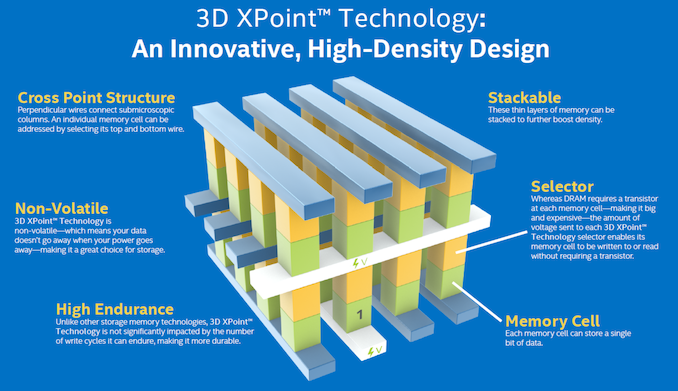
Intel, in turn, used 3D XPoint as the basis of two product lineups. For its datacenter customers, it offered Optane Persistent Memory, which packaged 3D XPoint into DIMMs as a partial replacement for traditional DRAMs. Optane DIMMs offered greater bit density than DRAM, and combined with its persistent, non-volatile nature made for an interesting offering for systems that needed massive working memory sets and could benefit from its non-volatile nature, such as database servers. Meanwhile Intel also used 3D XPoint as the basis of several storage products, including high-performance SSDs for the server and client market, and as a smaller high-speed cache for use with slower NAND SSDs.
3D XPoint’s unique attributes have also been a challenge for Intel since the technology launched, however. Despite being designed for scalability via layer stacking, 3D XPoint manufacturing costs have continued to be higher than NAND on a per-bit basis, making the tech significantly more expensive than even higher-performance SSDs. Meanwhile Optane DIMMs, while filling a unique niche, were equally as expensive and offered slower transfer rates than DRAM. So, despite Intel’s efforts to offer a product that could crossover the two product spaces, for workloads that don’t benefit from the technology’s unique abilities, 3D XPoint ended up being neither as good as DRAM or NAND in their respective tasks – making Optane products a hard sell.
As a result, Intel has been losing money on its Optane business for most (if not all) of its lifetime, including hundreds of millions of dollars in 2020. Intel does not break out Optane revenue information on a regular basis, but on the one-off occasions where they have published those numbers, they have been well in the red on an operating income basis. As well, reports from Blocks & Files have claimed that Intel is sitting on a significant oversupply of 3D XPoint chips – on the order of two years’ of inventory as of earlier this year. All of which underscores the difficulty Intel has encountered in selling Optane products, and adding to the cost of a write-down/write-off, which Intel is doing today with their $559M Optane impairment charge.
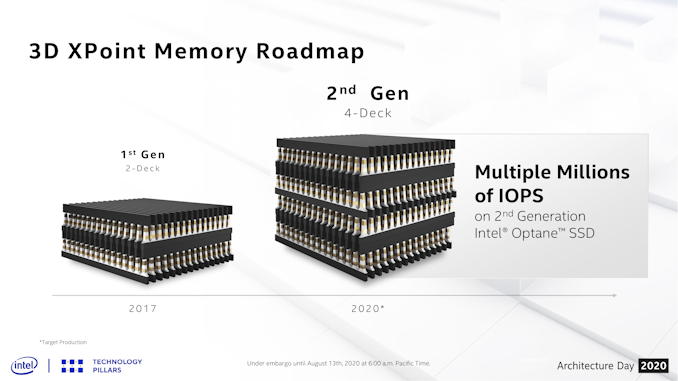
Consequently, a potential wind-down for Optane /3D XPoint has been in the tea leaves for a while now, and Intel has been taking steps to alter or curtail the business. Most notably, the dissolution of the Intel/Micron IMFT joint venture left Micron with possession of the sole production fab for 3D XPoint, all the while Micron abandoned their own 3D XPoint plans. And after producing 3D XPoint memory into 2021, Micron eventually sold the fab to Texas Instruments for other uses. Since then, Intel has not had access to a high volume fab for 3D XPoint – though if the inventory reports are true, they haven’t needed to produce more of the memory in quite some time.
Meanwhile on the product side of matters, winding-down the Optane business follows Intel’s earlier retreat from the client storage market. While the company has released two generations of Optane products for the datacenter market, it never released a second generation of consumer products (e.g. Optane 905P). And, having sold their NAND business to SK Hynix (which now operates as Solidigm), Intel no longer produces other types of client storage. So retiring the remaining datacenter products is the logical next step, albeit an unfortunate one.
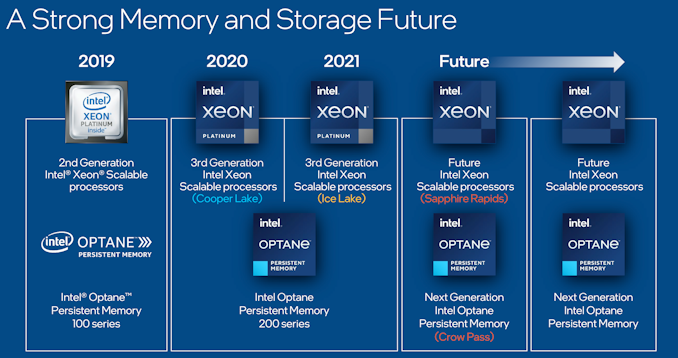
Intel's Former Optane Persistent Memory Roadmap: What WIll Never Be
Overall, Intel has opted to wind-down the Optane/3D XPoint business at a critical juncture for the company. With their Sapphire Rapids Xeon CPUs launching this year, Intel was previously scheduled to launch a third generation of Optane products, most importantly their “Crow Pass” 3rd generation persistent DIMMs, which among other things would update the Optane DIMM technology to use a DDR5 interface. While development of Crow Pass is presumably complete or nearly complete at this point (given Intel’s development schedule and Sapphire Rapids delays), actually launching and supporting the product would still incur significant up-front and long-term costs, requiring Intel to support the technology for another generation.
In lieu of Optane persistent memory, Intel’s official strategy is to pivot towards CXL memory technology (CXL.mem), which allows attaching volatile and non-volatile memory to a CPU over a CXL-capable PCIe bus. This would accomplish many of the same goals as Optane (non-volatile memory, large capacities) without the costs of developing an entirely separate memory technology. Sapphire Rapids, in turn will be Intel’s first CPU to support CXL, and the overall technology has a much broader industry backing.
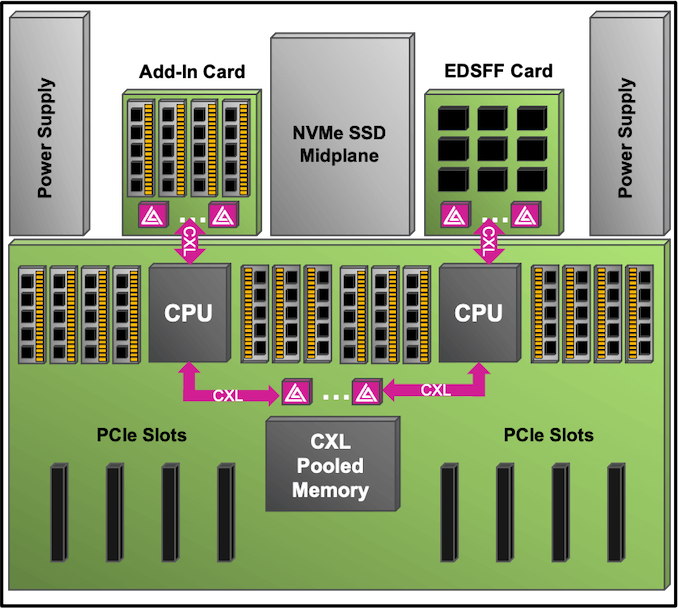
AsteraLabs: CXL Memory Topology
Still, Intel’s retirement of Optane/3D XPoint marks an unfortunate end of an interesting product lineup. 3D XPoint DIMMs were a novel idea even if they didn’t quite work out, and 3D XPoint made for ridiculously fast SSDs thanks to its massive random I/O advantage – and that’s a feature it doesn’t look like any other SSD vendor is going to be able to fully replicate any time soon. So for the solid state storage market, this marks the end of an era.
Source: Hacker News
Source: Hacker News
Source: Hacker News
Source: Ars Technica
Enlarge (credit: Getty Images)
Researchers have unpacked a major cybersecurity find—a malicious UEFI-based rootkit used in the wild since 2016 to ensure computers remained infected even if an operating system is reinstalled or a hard drive is completely replaced.
The firmware compromises the UEFI, the low-level and highly opaque chain of firmware required to boot up nearly every modern computer. As the software that bridges a PC’s device firmware with its operating system, the UEFI—short for Unified Extensible Firmware Interface—is an OS in its own right. It’s located in an SPI-connected flash storage chip soldered onto the computer motherboard, making it difficult to inspect or patch the code. Because it’s the first thing to run when a computer is turned on, it influences the OS, security apps, and all other software that follows.
On Monday, researchers from Kaspersky profiled CosmicStrand, the security firm’s name for a sophisticated UEFI rootkit that the company detected and obtained through its antivirus software. The find is among only a handful of such UEFI threats known to have been used in the wild. Until recently, researchers assumed that the technical demands required to develop UEFI malware of this caliber put it out of reach of most threat actors. Now, with Kaspersky attributing CosmicStrand to an unknown Chinese-speaking hacking group with possible ties to cryptominer malware, this type of malware may not be so rare after all.
Source: Ars Technica

Enlarge (credit: tupungato | iStock Editorial / Getty Images Plus)
When T-Mobile compromised the sensitive personal information of more than 76 million current, former, and prospective customers in 2021, plaintiffs involved in a class action lawsuit complained that the company continued profiting off their data while attempting to cover up “one of the largest and most consequential data breaches in US history.”
Now, T-Mobile has admitted no guilt but has agreed to pay a $500 million settlement (pending a judge’s approval), out of which $350 million will go to the settlement fund and “at least $150 million” will go toward enhancing its data security measures through 2023.
T-Mobile declined to tell Ars about specific upcoming plans to improve data security, instead linking to a statement that outlines measures it has taken to “double down” on security in the past year. That includes creating a Cybersecurity Transformation Office that directly reports to T-Mobile CEO Mike Sievert; collaborating with cybersecurity firms to “further transform our cybersecurity program;” ramping up employee cybersecurity training; and investing “hundreds of millions of dollars to enhance our current cybersecurity tools and capabilities.”